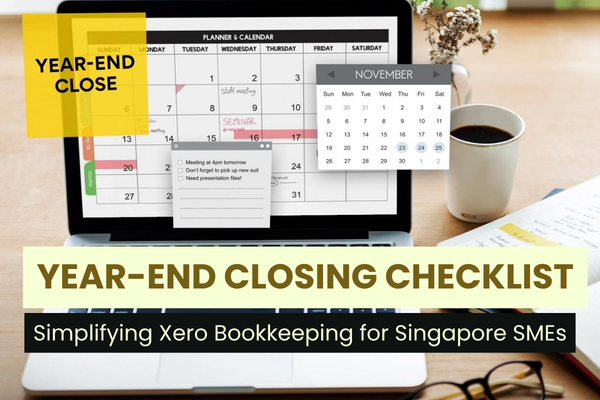
Year-end doesn’t have to mean panicked late nights and a mountain of loose receipts. For Singapore SMEs running Xero bookkeeping, most of the close is already done before you sit down to do it, because the reconciling happened month by month instead of all at once. This guide walks through the checklist, shows where Xero removes the manual work, and flags the Singapore-specific deadlines that sit alongside your accounting close.
Why Year-End Closing Catches SMEs Off Guard
The usual culprit isn’t the accounting itself. It’s a year of small gaps: a bank statement that never got reconciled in March, an invoice that was never followed up, a purchase that sat uncategorised in “Suspense” since June. None of these are hard problems on their own. Stacked up in December, they turn a routine close into a week of digging through inboxes and bank portals.
Businesses on cloud accounting software close faster mainly because the reconciliation habit is built into the month, not saved for year-end. That’s the difference this checklist is built around.
The Year-End Closing Checklist
1. Reconcile All Bank Accounts and Credit Cards
Match every bank and credit card transaction against your books for the full financial year, not just the last quarter. Look out for stale unreconciled items sitting in suspense accounts, duplicate entries from manual imports, and any account that was quietly left out of the monthly routine.
2. Review Outstanding Invoices and Follow Up on Overdue Payments
Pull an aged receivables report and go through it line by line. Chase anything overdue, write off what’s genuinely uncollectible with proper approval, and confirm any customer credit notes have been applied correctly. This step also gives you a realistic picture of year-end cash position, not just the number in the bank.
3. Confirm Inventory Counts Match Your Books
If you carry stock, do a physical count and reconcile it against what your books show. Differences usually point to unrecorded stock movements, timing issues between goods received and invoices processed, or shrinkage that needs to be written off properly for tax purposes.
4. Review and Categorise Uncoded Transactions
Every transaction sitting in a suspense or “ask my accountant” holding account needs a proper home before you close the year. Left uncoded, these distort your P&L and can trigger avoidable questions from your accountant or auditor during the review.
5. Check Fixed Asset and Depreciation Schedules Are Up to Date
Confirm every asset purchased or disposed of during the year has been added to or removed from the fixed asset register, and that depreciation has been run for the full period. This matters for both your financial statements and your corporate tax computation, since capital allowances are calculated off the same asset base.
6. Run Your Final Reports
Once the above is clean, generate your Profit & Loss, Balance Sheet, and GST F5 summary for the year. These three reports are what your accountant, auditor, and IRAS will all eventually see, so this is the point to catch anything that still looks off before it’s locked in.
How Xero Makes Year-End Closing Easier
Because bank feeds and reconciliation happen continuously through the year on Xero, most of this checklist is already half-finished by the time year-end arrives. A few features do most of the heavy lifting:
- Bank feeds and reconciliation mean there’s no scramble to track down twelve months of missing statements, because they were matched as the year went along.
- The Aged Receivables and Aged Payables reports update live, so chasing overdue invoices in step two is a five-minute report pull instead of a manual trawl through emails.
- Fixed Asset Manager runs depreciation automatically each month, so step five is a review, not a rebuild from scratch.
- Lock dates let you close off a period once it’s reconciled, so nothing from a finished month can be accidentally edited later, which keeps the year-end numbers stable.
- Report packs in Xero can generate P&L, Balance Sheet, and GST summaries together, formatted and ready to hand to your accountant.
None of this replaces good habits during the year. What it does is make those habits far easier to keep, so year-end becomes a review rather than a rebuild.
Singapore-Specific Deadlines to Track Alongside Your Close
Your accounting year-end triggers a sequence of statutory deadlines. Missing one doesn’t just mean a late fee, it can hold up the next filing in the chain.
| Filing | Deadline | Authority |
|---|---|---|
| GST F5 return | Within 1 month after the end of each accounting period (usually quarterly) | IRAS |
| Estimated Chargeable Income (ECI) | Within 3 months after financial year-end | IRAS |
| Annual General Meeting (if not exempted) | Within 6 months after financial year-end | ACRA |
| Annual Return | Within 7 months after financial year-end (private companies) | ACRA |
| Corporate Income Tax (Form C-S / C-S Lite / C) | By 30 November of the following year | IRAS |
If your business is GST-registered, note that the standard rate is 9%, and IRAS’s Regulations 26 and 27 block input tax claims on certain expense categories (such as private motor vehicle costs and most staff medical and insurance expenses) even when the invoice is otherwise in order. Cleaning up your uncoded transactions at year-end is a good moment to check nothing was claimed against those categories in error.
Common Year-End Mistakes Singapore SMEs Make
- Leaving reconciliation entirely to December. A year of bank statements is far harder to match retroactively than a month’s worth, especially if a signatory or payment method changed partway through the year.
- Writing off bad debts without proper documentation. IRAS requires evidence that recovery efforts were genuinely made before a debt qualifies for tax deduction.
- Missing the ECI filing because it’s due before the “real” tax return. ECI is often overlooked because it falls just three months after year-end, while people mentally file “tax season” as a mid-year event.
- Forgetting to update the fixed asset register for disposals. An asset that was scrapped or sold but never removed from the register keeps depreciating on paper, which understates profit and overstates asset value.
- Not exporting or backing up the closed financial year. Once a period is locked, it’s good practice to keep an exported copy of the final reports outside the live system as well.
Starting the New Year Right
A clean close isn’t just about ticking boxes for the accountant. It’s the foundation for accurate budgeting, informed decisions, and a business owner who can walk into January knowing exactly where they stand, instead of guessing.
The best year-end close is the one you barely notice happening.
Get Your Books Year-End Ready
If your Xero file needs cleaning up before the year closes, or you’re setting up Xero for the first time and want it configured to make next year-end easier than this one, 361DC works with Singapore SMEs as a Xero implementation and advisory partner. Contact us at 6515 7906 or enquiry@361dc.com to get your bookkeeping ready before the deadlines stack up.
Frequently Asked Questions
Ideally, the process runs continuously through the year via monthly reconciliation. The formal closing checklist itself typically takes one to two weeks once the financial year has ended, assuming the books were kept current throughout the year.
Yes. GST-registered businesses must file a GST F5 return for every accounting period, even a “nil” return with no transactions, within one month of the period end.
Late filing attracts penalties starting from a few hundred dollars and increasing the longer the filing is overdue. Repeated late filing can also lead to further enforcement action against the company and its directors.
Yes. Xero's Fixed Asset Manager calculates depreciation on a monthly basis once an asset is set up correctly, using the depreciation method and rate you specify.
No. The standard rate of 9% applies to most goods and services, but some supplies are zero-rated (such as exports and international services) or exempt (such as most financial services and residential property sales).
The bookkeeping steps apply the same way, but sole proprietorships don't file an ACRA Annual Return. Income is reported through the owner's personal income tax filing instead of a separate corporate tax return.
Transactions can generally be recategorised at any point before the financial statements are finalised and the accounting period is locked. Once GST returns for a period have been filed, corrections to that period may need to go through a separate amendment process with IRAS rather than a simple recode.