
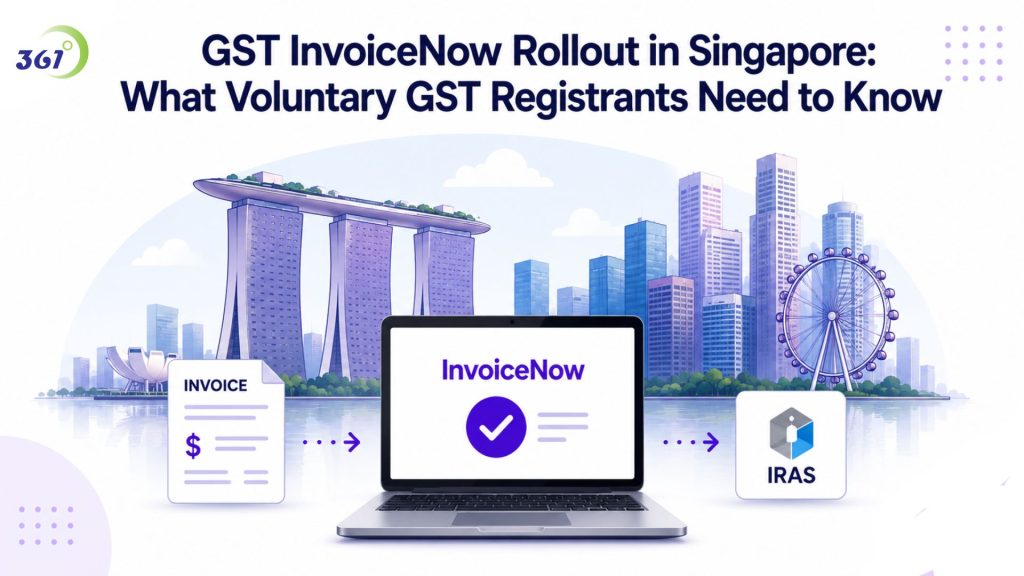
GST InvoiceNow is becoming mandatory for GST-registered businesses in Singapore. Learn who is affected, key dates, and what voluntary GST registrants must do to stay compliant and prepared.
GST InvoiceNow Rollout: Who it Affects and What to Do Next
Singapore’s GST InvoiceNow rollout is changing how GST-registered businesses transmit invoice data to IRAS through the nationwide InvoiceNow e‑invoicing network. For businesses considering voluntary GST registration, or those that have just registered voluntarily, this means you now need to plan for both GST compliance and InvoiceNow readiness from day one.
What GST InvoiceNow Is
GST InvoiceNow is IRAS’s requirement for GST-registered businesses to use InvoiceNow‑ready solutions to send prescribed invoice data directly to IRAS, in addition to normal invoicing between suppliers and customers. It is built on the Peppol-based InvoiceNow network managed by IMDA, which allows invoices to move electronically and in a structured format between finance systems. In practical terms, your accounting or ERP system must be InvoiceNow‑enabled and able to transmit Mandatory Data Elements (MDEs) to IRAS.
Who is Affected by the Rollout
The requirement applies to GST‑registered businesses, but the rollout is phased by date of registration and company’s revenue. Current policy makes InvoiceNow adoption a condition of voluntary GST registration for new registrants, and it will eventually extend to all GST‑registered businesses by 1 April 2031.
Existing GST‑registered businesses will be required to onboard InvoiceNow and submit invoice data directly to IRAS via the InvoiceNow network in phases based on their annual supplies, starting from 1 April 2028.
For businesses considering voluntary GST registration now, you should assume InvoiceNow is part of the package, not an optional extra. If you have just registered voluntarily on or after the relevant start dates, you are already within the InvoiceNow requirement and must ensure your systems can comply.
Key Dates for Voluntary GST Registrants
The key dates that matter most for voluntary GST registrants are:
- From 1 November 2025: Newly incorporated companies that register for GST voluntarily must adopt InvoiceNow.
- From 1 April 2026: All new voluntary GST registrants, regardless of business structure, must use InvoiceNow‑ready solutions as a condition of registration.
From these dates onwards, IRAS treats InvoiceNow adoption as part of the voluntary GST registration conditions and may reject applications that do not meet the technology requirement.
From 1 April 2028, existing GST‑registered businesses will be phased in based on their total annual supplies until all GST registrants must transmit invoice data via InvoiceNow by 1 April 2031.
What Voluntary Registrants Need to Do
1. Before Registering for GST Voluntarily
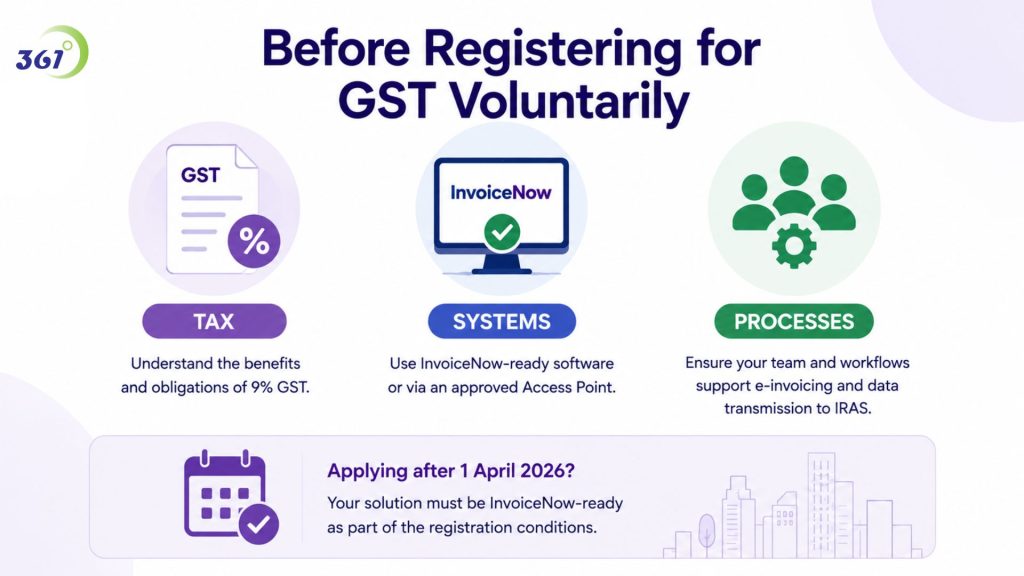
Businesses that are below the S$1 million turnover threshold can register for GST voluntarily, mainly to claim input tax and improve commercial credibility, but they must commit to staying registered for at least two years and meeting all compliance conditions. With InvoiceNow added to the mix, you should plan along three dimensions:
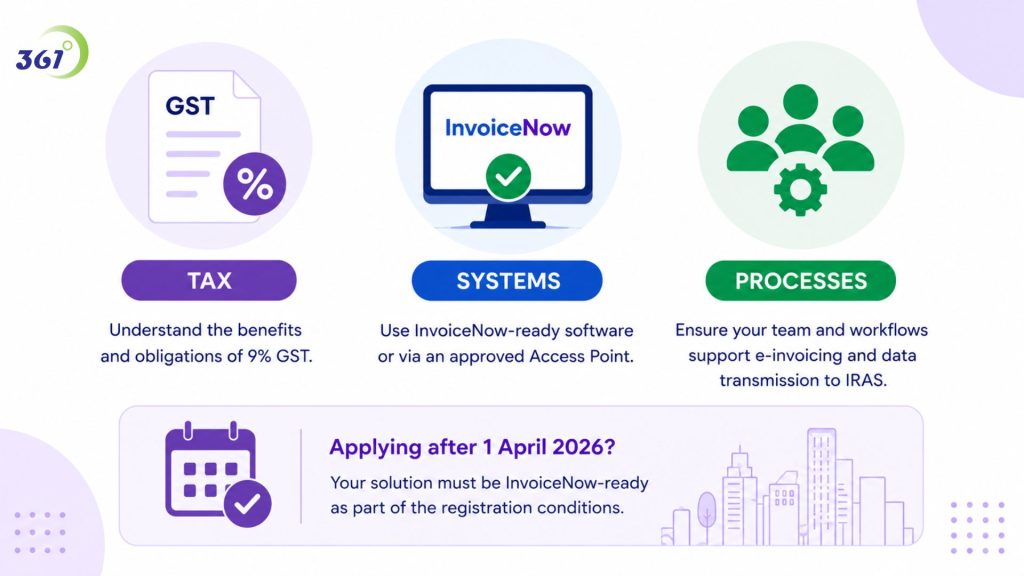
- Tax: Understand the benefits and obligations of charging and claiming 9% GST.
- Systems: Confirm that your accounting or invoicing software is InvoiceNow‑ready or can be enabled via an approved Access Point provider.
- Processes: Ensure your team and workflows can support structured e‑invoicing and data transmission to IRAS.
If you are applying for voluntary GST registration after 1 April 2026, make sure your chosen solution is InvoiceNow‑ready before submitting your application, as this is part of the registration conditions.
2. After You’ve Registered Voluntarily
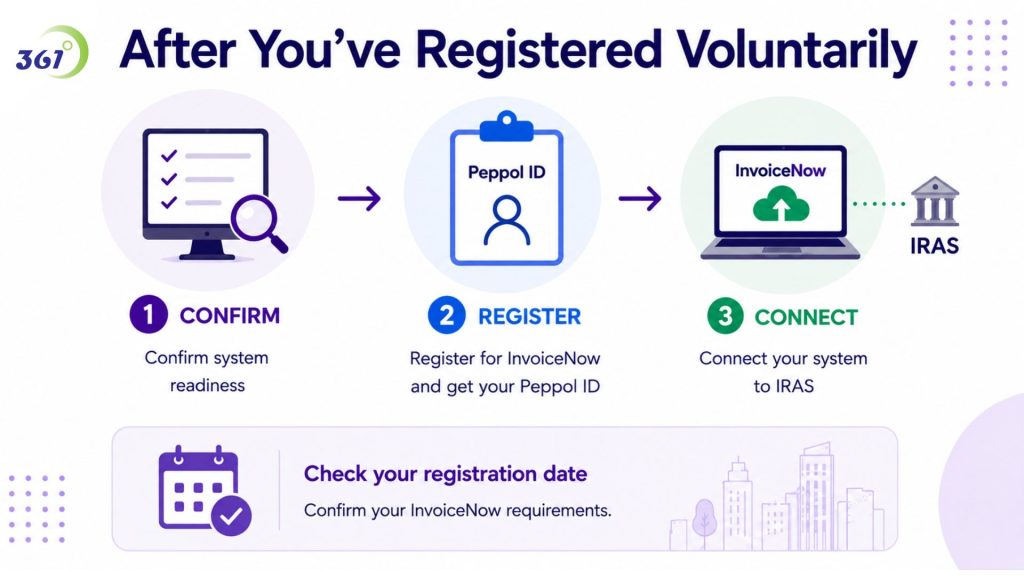
If you have already registered for GST voluntarily, start by checking whether your registration date falls after the relevant InvoiceNow start date for voluntary registrants. If it does, you should:
- Confirm that your accounting or ERP system appears on IMDA’s list of Peppol‑Ready / InvoiceNow‑ready solutions or is connected via an Access Point.
- Register for InvoiceNow with your provider and obtain a Peppol ID, then connect your system to IRAS via API or the agreed channel.
- Test end‑to‑end submission of invoice data to IRAS before your first GST filing deadline, ensuring all mandatory data fields are complete and accurate.
You should also review your invoice approval, customer and supplier master data, and month‑end reconciliation processes, because the quality of the data in your system determines whether your InvoiceNow transmission and GST returns stay aligned.
Practical Action Checklist for Small Businesses
For SMEs considering voluntary GST registration or recently registered, here is a simple checklist:
- Confirm your GST status and registration date to see which InvoiceNow rules apply.
- Verify that your accounting/invoicing solution is InvoiceNow‑ready (Peppol‑Ready) and connected to the nationwide network.
- Work with your provider or an Access Point to set up InvoiceNow, obtain a Peppol ID, and integrate with IRAS for invoice data transmission.
- Train staff on the new workflow: how invoices are created, approved, and transmitted, and what to do when data validation fails.
- Put in place regular reconciliations between invoice data, GST returns, and financial statements to catch issues early.
Thinking of it simply: the GST decision is about tax and cash flow, while InvoiceNow readiness is about systems and operations. Planning for both together reduces stress, surprises and makes your GST journey smoother.
Planning to register for GST voluntarily?
Contact us today at 6515 7906 or enquiry@361dc.com to prepare your business for GST InvoiceNow with confidence.