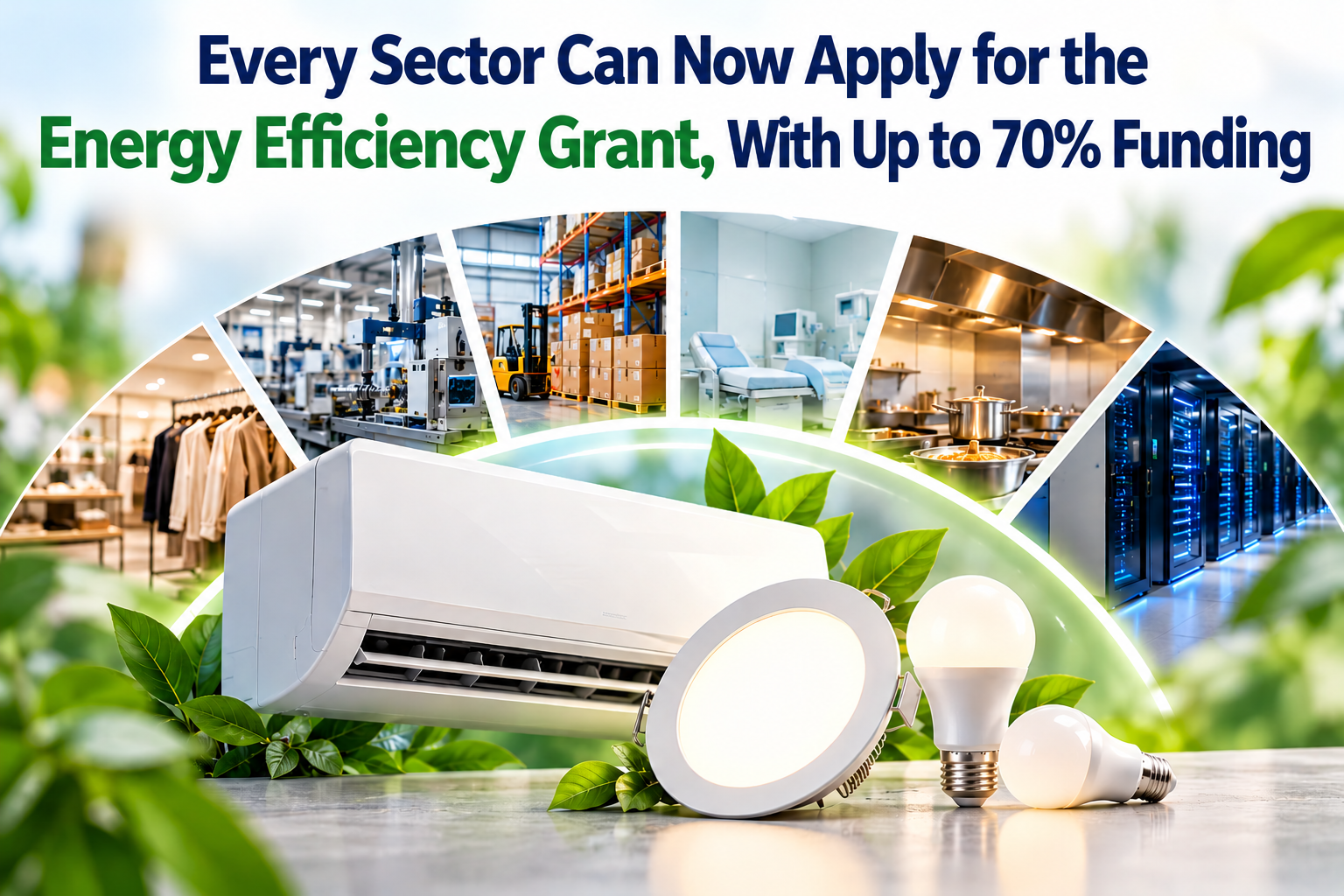

If your business was left out of the Energy Efficiency Grant (EEG) before, that has changed. The good news is that the EEG Base Tier is now open to all companies from every sector, and applications can run until 31 March 2028.
Previously under the old scheme, only six sectors could apply. An accounting firm, a clinic, a tuition centre or a logistics company had no way in. Now, any eligible company can claim up to 70% of the cost of qualifying energy-efficient equipment, up to S$30,000 per company.
Below you’ll find what changed, who qualifies, what the grant pays for, and the common mistakes that tend to get applications into trouble.
What is the Energy Efficiency Grant?
The EEG is a government scheme that pays part of the cost when a business buys energy-efficient equipment. You apply through the Business Grants Portal (BGP), and there are two tiers.
The Base Tier covers pre-approved equipment. SMEs can get up to 70% of the cost and non-SMEs up to 30%, with a cap of S$30,000 per company. This is the tier that is now open to all sectors until 31 March 2028.
The Advanced Tier is only for Construction and Manufacturing companies. The equipment doesn’t have to be pre-approved, but it must show energy savings above 350 tonnes of lifetime carbon abatement. Support across both tiers is capped at S$350,000, and applications close on 31 March 2027.
Everything below is about the Base Tier. The Advanced Tier hasn’t changed.
What has changed since the earlier version?
The sector restriction on the Base Tier is gone, and the deadline has moved out by a year. The table below shows the differences.
| Before | Now | |
|---|---|---|
| Eligible sectors (Base Tier) | Six sectors, namely Construction, Data Centre users, Food Services, Manufacturing (including Food Manufacturing), Maritime and Retail | All sectors, through EEG (Base) – Generic |
| Base Tier deadline | 31 March 2027 | 31 March 2028 |
| Equipment for businesses outside the six sectors | None available | Air-conditioners and LED lighting (generic list) |
| Support rates | Up to 70% (SME), 30% (non-SME) | Unchanged |
| Cap per company | S$30,000 | Unchanged |
| Advanced Tier | Construction and Manufacturing, until 31 March 2027 | Unchanged |
Who can apply for the EEG?
A company from any sector can apply for the generic equipment list as long as it meets these conditions.
- It is registered or incorporated in Singapore.
- It has at least 30% local shareholding (maritime companies and data centre users are exempt from this).
- Its group annual sales turnover is no more than S$500 million.
- It is not a charity, Institution of a Public Character, religious entity, Voluntary Welfare Organisation, government agency or subsidiary, co-operative society or society.
- It is not a home-based business and doesn’t operate from a residential address.
Sole proprietors and partnerships can apply too, provided they meet the same conditions.
Your company size decides your support rate. An SME is defined as a business with group annual sales turnover of no more than S$100 million or group employment of no more than 200 workers.
If you’re already in one of the original six sectors
Nothing is taken away from you. You can keep using your sector-specific equipment list, and you can use the generic list as well. For sector-specific applications, your sector is matched against the primary or secondary SSIC code registered with ACRA.
What equipment does the EEG cover?
Companies applying under the generic list can claim for two categories for now, air-conditioners and LED lighting. Click the links to check out the pre-approved models, as only these can qualify and there are technical requirements to meet too. The government says it will keep reviewing the list and may add more categories where there is clear industry demand and energy-saving potential.
Companies in the original sectors have longer lists to choose from, as shown below.
| Sector | Additional pre-approved equipment |
|---|---|
| Construction | Battery energy storage system, electric crawler crane, electric excavator, electric wheel loader, hydraulic excavator |
| Food Services and Retail | Clothes dryer, cooking hob, refrigerator, water heater |
| Manufacturing (including Food Manufacturing) | Boiler system, clothes dryer, compressed air system, cooking hob, motors, refrigerator, water heater |
| Maritime (port) | Electric forklift |
| Data centre users | Data centre storage, enterprise servers |
What the grant doesn’t pay for
Only hardware costs are supported. GST, maintenance, and used, refurbished, second-hand or reconditioned equipment are all excluded, so factor those in when you work out your payback.
How much funding can you get?
SMEs can get up to 70% of qualifying costs and non-SMEs up to 30%, up to S$30,000 per company. Say you’re replacing air-conditioners and the qualifying hardware cost is S$12,000 before GST. The table shows how the split would work.
| SME (70%) | Non-SME (30%) | |
|---|---|---|
| Qualifying hardware cost | S$12,000 | S$12,000 |
| Grant | S$8,400 | S$3,600 |
| Your share | S$3,600 | S$8,400 |
Treat this as an example only. The final amount depends on which costs are assessed as qualifying.
The cap catches a lot of people out. The S$30,000 limit runs from 1 April 2024 to 31 March 2028 and counts everything you claim under the Base Tier, generic and sector-specific together. If your company has already received EEG support in that period, you only have the balance left. Once it is used up, there is no more EEG support until the period ends.
How to apply for the Energy Efficiency Grant step by step
- Check that you’re eligible. Go through the conditions above, especially local shareholding and turnover.
- Pick equipment from the pre-approved list. Your chosen models need to come from this list.
- Get quotations. Ask your vendor for formal quotes for the exact models.
- Don’t sign or pay anything yet. A deposit or payment made before you submit counts as a retrospective application, and those aren’t supported.
- Submit on the BGP. You’ll need a CorpPass account. You must apply for yourself, as vendors can’t apply on your behalf.
- Wait for the outcome. An EEG (Base) application usually takes 4 to 10 weeks once your documents are complete, and it may take longer in the weeks after a new list launches. You can buy before you hear back, but you can’t claim if the application is unsuccessful.
- Buy, install and claim. You have up to one year from approval. Claims need the invoice, proof of payment, delivery order, installation photos and equipment serial numbers.
- Hold on to the equipment. You must keep it for at least one year after your final claim is approved.
Mistakes that can cost you the grant
The official FAQ is clear on several points that applicants often get wrong.
- Paying a deposit before you apply. This alone can get the application rejected.
- Changing vendor or model after approval. It isn’t allowed, so you’d have to terminate the application and resubmit before paying the new vendor.
- Missing the claim due date. You get one extension only, and you have to request it before the due date passes.
- Using a connected vendor. Your vendor can’t have any relationship with your company, its related companies, directors or common shareholders, and you must declare any relationship.
- Accepting vendor freebies. You can’t receive free items or other incentives connected to the purchase.
- Losing eligibility midway. If your local shareholding drops below 30% after approval, for example, your claim won’t be supported.
Is it worth applying?
That depends on what you run and how old it is. The generic list is narrow, so the grant suits businesses with ageing air-conditioners or older lighting that are due for replacement anyway. Offices, clinics, schools, shops and warehouses that run long hours are the obvious ones.
Before you decide, put three numbers side by side. These include the quote for the pre-approved model, the grant amount, and the costs the grant leaves out, such as GST and maintenance. Then look at how much of your electricity bill goes to cooling and lighting. That tells you whether the payback makes sense.
Also remember that the EEG pays for equipment only. Projects like digitalisation or capability building fall under other schemes, such as the EDGE Grant.
Frequently Asked Questions
Yes, for the Base Tier. Companies in any sector that meet the eligibility conditions can apply for the generic equipment list, and the Base Tier runs until 31 March 2028.
Up to 70% of qualifying equipment costs, capped at S$30,000 per company across the whole Base Tier period. Non-SMEs can get up to 30%.
For now, air-conditioners and LED lighting from the whitelisted generic list. The government may add more categories later.
The Base Tier is available until 31 March 2028. The Advanced Tier, for Construction and Manufacturing, closes on 31 March 2027.
No. Retrospective applications aren’t supported, and that includes paying an initial deposit to the vendor before you submit.
No. Home-based businesses and businesses operating from residential addresses aren’t eligible for EEG equipment.
Yes. Multiple and concurrent EEG (Base) applications are allowed, but the S$30,000 cap covers all of them together.
An EEG (Base) application usually takes 4 to 10 weeks after the full set of documents is received. It may take longer right after a new equipment list launches.