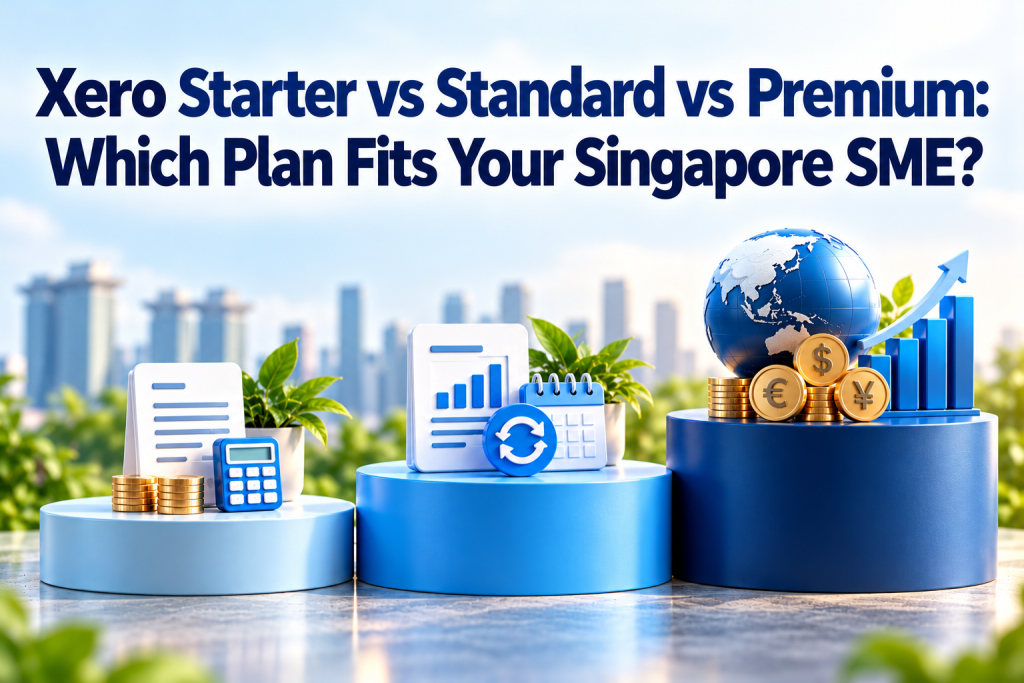
Choosing a Xero plan comes down to three questions: how many invoices and bills you process each month, whether you deal in foreign currencies, and how much reporting you want built in. Pick wrong and you either pay for features nobody opens, or hit the Starter limits in your second month.
This guide compares Xero’s three Singapore plans using the SGD prices in effect from 1 November 2026. It explains who each plan suits and answers the setup and grant questions new SMEs most often ask our team at 361DC.
Quick Answer: Which Xero Plan Should You Choose?
- Starter (S$42/month): sole proprietors and new businesses that send up to 20 invoices and enter up to 5 bills a month.
- Standard (S$77/month): most Singapore SMEs. No invoice or bill caps, plus bulk and automatic bank reconciliation, budgets and custom dashboards.
- Premium (S$99/month): businesses that invoice, pay or bank in foreign currencies, or want KPI analysis and a 180 day cash flow forecast.
From the SMEs we implement, Standard is where most growing businesses settle. Treat it as the default unless you clearly fit Starter or already transact in foreign currencies.
Xero Singapore Pricing (Effective 1 November 2026)
Xero updated its Singapore pricing on 1 November 2026 for both new and existing subscribers. All prices are in SGD and include GST.
| Plan | Monthly price | Annual cost | Best for |
|---|---|---|---|
| Starter | S$42 | S$504 | Sole traders and new businesses |
| Standard | S$77 | S$924 | Most growing SMEs |
| Premium | S$99 | S$1,188 | Multi-currency businesses |
Two other points matter if you are budgeting:
- The multi organisation discount no longer applies from 1 November 2026. If you run several entities on Xero, budget the full price for each one.
- Introductory offers change often. Xero regularly runs discounts for new Singapore subscribers, so check the current offer before you buy.
Add-ons are billed on top of the plan. Employee expense and mileage claims start from S$6 a month, and project time and cost tracking starts from S$10 a month, on any plan.
Xero Plan Comparison: Features Side by Side
| Feature | Starter | Standard | Premium |
|---|---|---|---|
| Invoices and quotes | Quotes + 20 invoices/month | No cap | No cap |
| Bills | 5 bills/month | No cap | No cap |
| Bank reconciliation | Yes | Yes | Yes |
| Bulk reconcile | No | Yes | Yes |
| Auto reconcile | Add-on (S$8/month) | Included | Included |
| Smart document capture (Hubdoc) | Yes | Yes | Yes |
| Accept online invoice payments | Yes (fees apply) | Yes (fees apply) | Yes (fees apply) |
| Cash flow forecast | 30 days | 60 days | 180 days |
| Budgets | No | 3 budgets | Included |
| Health scorecards and custom dashboards | No | Yes | Yes |
| KPIs, ratios and industry benchmarking | No | No | Yes |
| Multi-currency | No | No | Yes |
Source: Xero Singapore pricing page, checked 29 October 2026.
Xero Starter: Who It Suits and Where It Falls Short
Best for
Freelancers, sole proprietors, small consultancies with a handful of retainer clients, and newly incorporated companies that are not yet trading at volume.
Limits to watch
- The 20 invoice cap covers both approving and sending invoices. Invoices created by connected apps, such as a POS or e-commerce integration, can also count towards it.
- Five bills a month disappears fast. Rent, utilities, telco, a couple of software subscriptions and your corporate secretary fee already add up to five.
- No bulk reconciliation. Matching bank lines one at a time becomes slow once volume picks up.
A useful rule of thumb: Starter plus the auto reconcile add-on costs S$50 a month. Standard is only S$27 more and removes every cap, so do the sums before stacking add-ons on Starter.
Xero Standard: The Default for Most Singapore SMEs
Standard removes the invoice and bill limits and adds the tools that save time at month end. It suits F&B outlets, retailers, professional services firms and local trading companies that deal only in SGD.
- Bulk and auto reconciliation cut down the hours your admin staff spend matching bank transactions.
- Three budgets let you track budget against actuals, for example by outlet, department or project.
- A 60 day cash flow forecast and health scorecards give owners an early view of upcoming shortfalls.
The one notable gap is multi-currency. If you pay a single overseas supplier in USD, Standard means converting each transaction manually
Xero Premium: When Multi-Currency Makes It Worth It
Many Singapore SMEs buy from regional suppliers or bill overseas customers. Premium is the only Xero plan that handles multiple currencies, covering foreign currency invoices, bills and bank accounts, with exchange gains and losses calculated for you.
Consider a distributor that pays a supplier in China in USD and holds a USD account with its bank. On Standard, someone converts every transaction and posts the exchange difference by journal. On Premium, Xero does this automatically. The S$22 monthly difference is usually recovered quickly through less manual work and fewer reconciliation errors.
Premium also adds KPI and ratio analysis, industry benchmarking and a 180 day cash flow forecast, which help when owners are preparing for bank financing or reporting to investors.
GST and InvoiceNow: Does the Plan Matter?
Xero supports GST return filing (GST F5 and F8) directly to IRAS and is an IMDA accredited InvoiceNow-Ready Solution Provider, so all three plans can be used by GST registered businesses. The bigger question is timing. Under the IRAS GST InvoiceNow Requirement:
- Newly incorporated companies that voluntarily register for GST have been required to transmit invoice data via InvoiceNow since 1 November 2025.
- All new voluntary GST registrants have been covered since 1 April 2026.
- New compulsory GST registrants come into scope from 1 April 2028.
- Existing GST registered businesses are being phased in between 2028 and 2031, with all GST registered businesses covered by 1 April 2031.
IRAS has been notifying businesses registered before 2026 of their own implementation date. If you plan to register for GST voluntarily, set up InvoiceNow as part of your Xero implementation rather than as a separate project later.
Can You Get a Grant for Xero?
Yes. Since 30 September 2026, Enterprise Singapore’s EDGE Grant has replaced the Productivity Solutions Grant (PSG), the Enterprise Development Grant (EDG) and the Market Readiness Assistance (MRA) grant for new applications. If you read older articles that mention PSG for Xero, EDGE is now the route.
Here is how EDGE works for accounting software:
- Support levels depend on the activity. EDGE offers up to 70% for SMEs and up to 50% for non SMEs. Digital solutions such as cloud accounting are generally supported at up to 50% for SMEs.
- Caps: up to S$100,000 per company per year across all EDGE activities, of which up to S$30,000 can go to digital solutions, enterprise systems and selected automation.
- Pre-approved vendors: for activities that require one, you choose a pre-approved vendor and solution. These are typically processed faster than projects using a vendor of your choice.
- Non SMEs can now apply, which was not possible under PSG.
To qualify, your business generally needs to:
- Be registered and operating in Singapore
- Have at least 30% local shareholding by Singapore Citizens or PRs
- Be starting a new project, not one already under way
The most common mistake: paying the vendor, signing a contract or even placing a deposit before submitting your application. Retrospective applications are not supported. Applications are made through the Business Grants Portal, and you cannot switch vendors after applying, so settle your plan and vendor first.
Implementation Mistakes That Cost SMEs Time
The plan is only part of the decision. These are the issues we fix most often when SMEs set up Xero on their own:
- Starting on Starter to save money, then upgrading in month two. Xero only lets you downgrade one month after an upgrade, so pick based on realistic volume.
- Incorrect GST tax codes and chart of accounts. Errors here flow straight into your GST F5.
- Migrating years of messy history. Usually it is cleaner to bring over opening balances plus open receivables and payables.
- Not connecting bank feeds on day one. Manual statement imports defeat the purpose of reconciliation features you are paying for.
- Skipping staff training. Features like bulk reconcile only save time if your team knows how to use them.
361DC handles plan selection, setup, migration from spreadsheets or desktop accounting software, staff training and grant application guidance, so your Xero file is right from the first GST filing.
How to Choose Your Xero Plan in 4 Steps
- Count your invoices and bills over the last three months. More than 20 invoices or 5 bills in any month rules out Starter.
- Check for foreign currency. Any regular non-SGD invoices, bills or bank accounts point to Premium.
- Decide what reporting you need. Budgets and dashboards need Standard. KPI analysis and benchmarking need Premium.
- Plan for the next 12 months. Factor in add-ons, new entities and your expected InvoiceNow date.
Not Sure Which Plan Fits? Talk to 361DC
A 20 minute conversation about your invoice volume, currencies and grant eligibility is usually enough to pick the right plan and avoid paying for an upgrade you did not need. Our team can also scope an EDGE supported implementation so your setup, migration and training are covered from day one.
Call 6515 7906 or email enquiry@361dc.com to speak with a Xero specialist.
Frequently Asked Questions
Yes. You can upgrade at any time. If you move to a cheaper plan, Xero allows this one month after your last upgrade.
Yes. Xero’s listed Singapore prices are in SGD and include GST.
Only Premium. Starter and Standard handle a single currency.
No. Xero plans include unlimited users, so adding your accountant or admin staff does not increase the subscription.
Yes. Xero offers a 30 day free trial with access to its features, after which you choose a plan.
No. PSG closed to new applications on 29 September 2026. Xero adoption is now funded under the EDGE Grant, which generally supports up to 50% of eligible costs for digital solutions for SMEs. Apply before making any payment.
It depends on when and how you registered for GST. New voluntary registrants are already covered. Existing GST registered businesses will be phased in between 2028 and 2031, and IRAS notifies each business of its date.