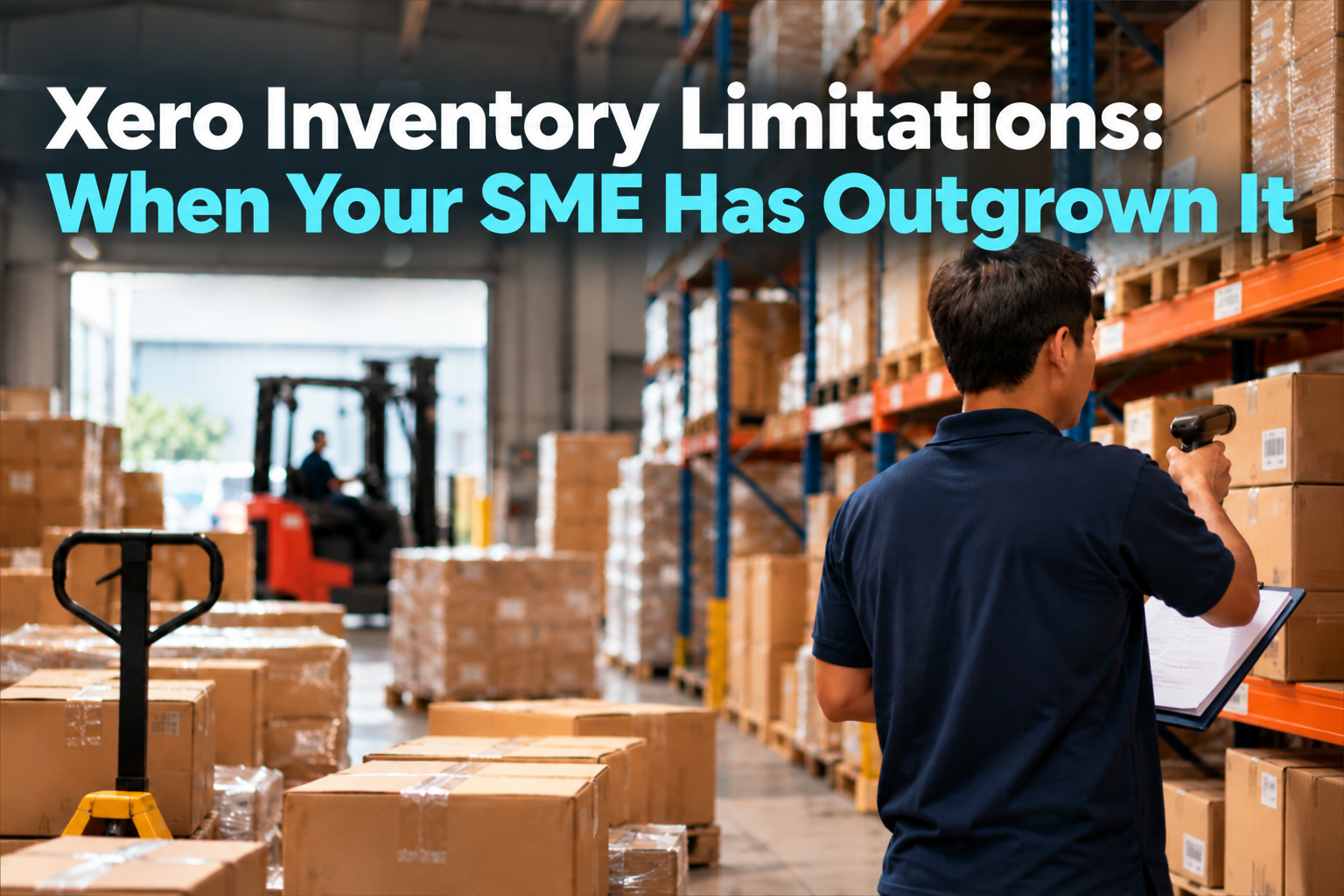

Xero’s built-in inventory works well for a simple buy-and-sell business: one stock location, a modest product range and basic costing. It tracks quantity and value for up to 4,000 items using average cost.
Wholesalers and distributors tend to reach its limits sooner than other SMEs. A second warehouse, batch-tracked goods or import shipments with freight to allocate are usually enough. This guide sets out what Xero inventory can and cannot do, the signs that you have outgrown it, and what to look for in the system that comes next.
What Xero inventory does well
Xero’s tracked inventory is a perpetual stock record built into the accounting ledger. Each sales invoice reduces quantity on hand and posts cost of goods sold. Each bill increases stock and updates the item’s average cost.
For a small trading business, that covers a lot:
- Quantity on hand and stock value for each tracked item
- Purchase orders that convert into bills
- Stock adjustments after a stocktake or write-off
- Item-level sales and stock value reports
- CSV import and export of the item list
Because stock and accounts live in one system, there is nothing to reconcile between them. That simplicity is the main strength of the feature. It is also why the limits below are firm.
Xero inventory limitations at a glance
| Area | What Xero does | Impact on wholesalers and distributors |
|---|---|---|
| Item limit | Up to 4,000 tracked items | Large catalogues and product variants reach the ceiling |
| Stock locations | One quantity on hand per item | No view of stock by warehouse, showroom or 3PL |
| Costing method | Average cost only | No FIFO or batch-specific costing |
| Batch, serial and expiry | No fields for these | No traceability for recalls, warranties or expiry-led picking |
| Landed cost | No allocation of freight or handling to items | Item margins look higher than they are |
| Negative stock | Not allowed for tracked items | Invoicing is blocked until the purchase is entered |
| Units of measure | One unit per item | Buying by carton and selling by piece needs workarounds |
| Assemblies and kits | No bill of materials | Bundles and repacked goods need manual adjustments |
| Order allocation | Quotes and invoices, with no stock reservation | No split between available stock and committed stock |
Xero’s own Singapore website acknowledges that a business working across multiple locations will probably need something more advanced, and points to the inventory apps in the Xero App Store.
Why the negative stock rule catches distributors out
Xero will not let a tracked item fall below zero. If a container arrives on Friday and the supplier bill is entered the following Wednesday, your team cannot invoice that stock in between.
The usual workarounds are invoicing late, invoicing with a free-text line, or switching items to untracked. Each one damages the stock figures you were relying on.
6 signs your SME has outgrown Xero inventory
- You hold stock in more than one place. A second warehouse, a showroom, a 3PL or consignment stock at a customer’s premises all appear as one number in Xero.
- A spreadsheet runs alongside Xero. Batch numbers, expiry dates or serial numbers are kept in Excel, and only one person fully understands the file.
- Gross margin looks better in Xero than in the bank. Freight, insurance and handling sit in an expense account and never reach item cost.
- Invoices are delayed or raised outside the item list. Staff work around a zero stock balance because the goods are physically on the shelf.
- Sales staff promise stock that is already committed. Xero shows quantity on hand. It does not reserve stock against confirmed orders.
- Your item list is approaching 4,000. Variants by size, colour or pack size use up the limit faster than most owners expect.
One sign on its own may be manageable. Two or three together usually mean it is time to cost out the alternatives.
Worked example: how landed cost distorts margin
A Singapore distributor imports 1,000 units of a product:
- Supplier invoice: SGD 20,000
- Sea freight and insurance: SGD 2,400
- Port handling, permit and local trucking: SGD 600
- True landed cost: SGD 23,000, or SGD 23.00 per unit
Xero has no function to spread the freight and handling bills across the units. Unless someone revalues the item manually, it sits at SGD 20.00.
Sell each unit at SGD 28.00 and the item report shows a 28.6% margin. The real margin is 17.9%. The freight is still recorded, but as an expense when billed instead of a cost when the goods are sold. Closing stock is understated and pricing decisions rest on the wrong number.
For GST-registered businesses, import GST that you can claim as input tax is not part of landed cost.
Why stock records matter for Singapore compliance
IRAS requires companies to keep proper records for at least five years from the relevant Year of Assessment. Its record keeping checklist lists a stock list among the accounting records and schedules.
Closing stock also feeds directly into cost of sales, and therefore taxable profit. A year-end stock figure that depends on a spreadsheet only one employee can explain is a risk during an audit or a tax query.
What to look for in an inventory system that works with Xero
Most SMEs do not need to replace Xero. The common approach is to keep Xero as the accounting ledger and add a dedicated inventory system that syncs with it. When comparing options, check these points:
- Xero integration depth. Ask exactly what posts to Xero: invoices, bills, credit notes, cost of goods sold journals and stock adjustments.
- Multiple warehouses and bins, with stock transfers between them.
- Batch, serial and expiry tracking, if your products need traceability.
- Landed cost allocation by value, quantity, weight or volume.
- Multi-currency purchasing for overseas suppliers.
- Units of measure, so you can buy by the carton and sell by the piece.
- Sales orders with stock allocation and backorders.
- User permissions and an audit trail for stock adjustments.
Common mistakes when moving off Xero inventory
- Migrating dirty data. Duplicate item codes and wrong quantities move straight into the new system. Do a full stocktake first.
- Picking a poor cut-over date. A month end, ideally a financial year end, gives a clean opening balance.
- Running two stock ledgers. If Xero and the new system both post stock movements, you get double counting. Agree which system owns the stock ledger.
- Buying for today’s problem only. Choose for the products, locations and sales channels you expect over the next three to five years.
When Xero inventory is still enough
Staying put is the right call if you hold stock in one location, carry well under 4,000 items, have no batch or serial requirements, and buy mostly from local suppliers with little freight to allocate.
A dedicated system adds cost and process. Take it on when the limits are costing you, not before.
Not sure whether you have outgrown Xero inventory?
361DC implements Xero and connected business software for Singapore SMEs. If you recognise several of the signs above, we can review your current stock workflow, show you where the gaps are and outline your options, including whether staying on Xero inventory still makes sense.
Call us at 6515 7906 or email enquiry@361dc.com.
Frequently asked questions
Xero can track up to 4,000 inventory items by quantity and value. Businesses with larger catalogues, or many product variants, generally need a dedicated inventory system connected to Xero.
No. Xero holds a single quantity on hand for each item and has no warehouse, location or bin fields. Xero itself suggests more advanced software for businesses operating across multiple locations.
Average cost. Each purchase recalculates the item's average, and that figure is used for cost of goods sold. FIFO and batch-specific costing are not available in Xero's tracked inventory.
Not natively. Xero items have no batch, serial or expiry fields, so traceability needs an inventory app or a separate record.
At the time of writing, Xero Inventory Plus is offered to US customers only. Singapore businesses that need more than the standard inventory feature use a connected inventory app.
No. Most growing SMEs keep Xero for accounting, GST and reporting, then add an inventory system that syncs sales, purchases and stock values into it.