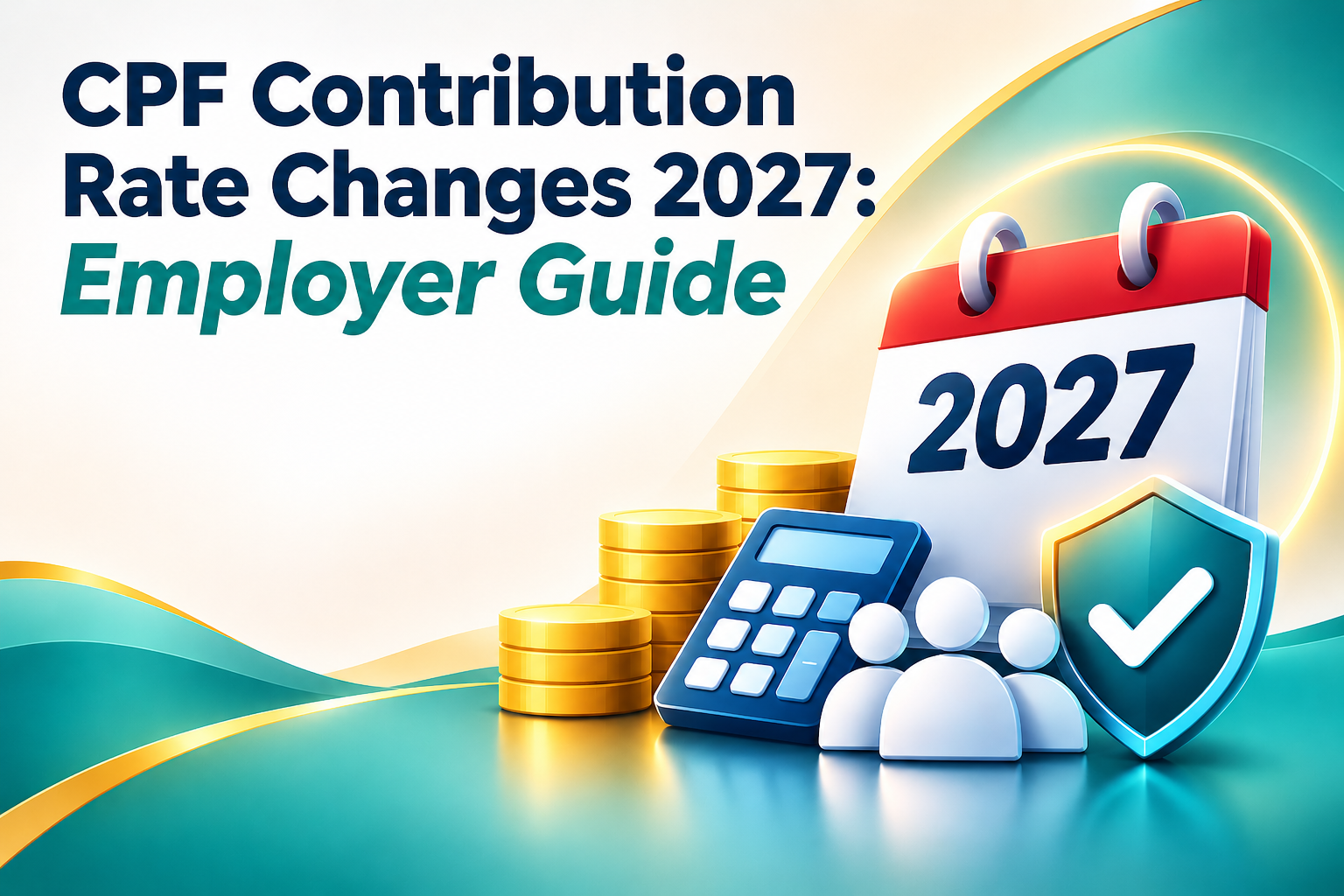

From 1 January 2027, the total CPF contribution rate rises from 34% to 35.5% for employees aged above 55 to 60, and from 25% to 26% for those above 60 to 65. Rates for every other age group stay the same.
The new rates apply to wages earned from 1 January 2027. The Ordinary Wage ceiling does not change this year, which makes this update easy to overlook. This guide covers the full rate table, what the increase costs, how the CPF Transition Offset helps, and the steps to update your payroll before the first January pay run.
This is a follow-up to our 2026 CPF guide, which covered the previous round of changes.
What Are the CPF Contribution Rates for 2027?
The table below shows the rates for employees earning more than $750 a month, including Singapore Citizens and Permanent Residents from their third year of PR status.
| Employee age | Employer share | Employee share | 2027 total | 2026 total |
|---|---|---|---|---|
| 55 and below | 17% | 20% | 37% | 37% |
| Above 55 to 60 | 16.5% (+0.5 pt) | 19% (+1 pt) | 35.5% | 34% |
| Above 60 to 65 | 13% (+0.5 pt) | 13% (+0.5 pt) | 26% | 25% |
| Above 65 to 70 | 9% | 7.5% | 16.5% | 16.5% |
| Above 70 | 7.5% | 5% | 12.5% | 12.5% |
What Changes From 1 January 2027?
Above 55 to 60
The employer share rises by 0.5 percentage point and the employee share by 1 percentage point. The combined increase is 1.5 percentage points.
Above 60 to 65
Both the employer and employee shares rise by 0.5 percentage point. The CPF Board says this increase brings the band to its target contribution rates.
Lower earners on phased-in rates
Senior workers earning more than $500 and up to $750 a month contribute at phased-in rates. These also increase proportionally from January 2027, so include them in your payroll update.
Where the extra contributions go
The additional contributions for employees aged above 55 to 65 go into the Retirement Account, up to the Full Retirement Sum. If an employee has already set aside the Full Retirement Sum, the extra amount goes to the Ordinary Account.
How Much Will the 2027 Increase Cost?
All amounts are in Singapore dollars. The figures apply CPF Board rates to the stated salary, and your payroll system’s calculation remains the final reference.
| Example | Employer CPF 2026 | Employer CPF 2027 | Employee CPF 2026 | Employee CPF 2027 |
|---|---|---|---|---|
| Age 58, $5,000 a month | $800 | $825 (+$25) | $900 | $950 (+$50) |
| Age 62, $4,000 a month | $500 | $520 (+$20) | $500 | $520 (+$20) |
Take a business with six employees aged above 55 to 60, each earning $5,000 a month. The employer share rises by $25 per person per month, which adds $150 a month or $1,800 across 2027. The CPF Transition Offset covers half of that increase, about $900, so roughly $900 remains for the business to absorb.
Each of those employees takes home $50 less a month, which is worth explaining before the first payslip goes out.
What Stays the Same in 2027?
- The Ordinary Wage ceiling stays at $8,000 a month. The phased increase from $6,000 finished in January 2026
- The annual salary ceiling stays at $102,000 with no change announced, and the Additional Wage ceiling formula still applies ($102,000 minus total Ordinary Wages subject to CPF for the year)
- Rates for employees aged 55 and below, above 65 to 70, and above 70 are unchanged
- Graduated rates for first- and second-year Permanent Residents are unchanged
- Foreign employees on Employment Passes, S Passes and Work Permits are still not covered by CPF
What Is the CPF Transition Offset (CTO) for 2027?
The CPF Transition Offset (CTO) is a one-year Government offset that covers half of the 2027 increase in the employer’s CPF contributions for every Singaporean and Permanent Resident employee aged above 55 to 65.
The employer share rises by 0.5 percentage point, so the offset works out to roughly 0.25 percentage point of wages, or about $12.50 a month for an employee earning $5,000. It reduces your cost only and does not change what you deduct from employees. Check the CPF Board’s CTO page for how the offset is credited to your account.
Two other schemes for senior workers, the Senior Employment Credit and the Part-Time Re-employment Grant, have both been extended to December 2027. Eligibility conditions apply, so check the current MOM requirements before budgeting around them.
Do the Higher Retirement and Re-employment Ages Affect Payroll?
Indirectly, yes. From 1 July 2026, the retirement age is 64 and the re-employment age is 69, up from 63 and 68. MOM’s roadmap is to reach 65 and 70 by 2030.
More of your staff will stay in the above 55 to 65 CPF bands for longer. If you plan manpower costs over several years, build the higher employer rates into those forecasts now.
How Do You Update Payroll for the 2027 CPF Changes?
- Load the 2027 rate table into your payroll system or spreadsheet before January, including the phased-in rates for senior workers earning $500 to $750.
- Set rates by the period the wages were earned, not the pay date. The CPF Board applies the new rates to wages earned from 1 January 2027, so December 2026 salary paid in January still uses the 2026 rates.
- Run test payslips and compare. An employee aged 58 earning $5,000 should show $825 employer and $950 employee CPF. An employee aged 62 earning $4,000 should show $520 each.
- Check age-band changes. Anyone turning 55, 60, 65 or 70 during the year should move to the right band at the right time.
- Update your 2027 cost forecast for employees aged above 55 to 65, and record the CTO separately from the gross increase.
- Tell affected staff before the first payslip that their take-home pay will drop slightly and that the extra CPF goes to their Retirement Account.
What Payroll Mistakes Should You Avoid in 2027?
- Reusing the 2026 rate table for January payroll
- Looking for an Ordinary Wage ceiling change that is not happening this year
- Switching rates on the pay date instead of the wage period
- Treating the two senior age bands the same, when the employee share rises by 1 point in one and 0.5 point in the other
- Leaving out senior workers earning $500 to $750 who are on phased-in rates
- Reading the CTO as a reduction in payroll deductions, when it is an offset to the employer’s cost
What Comes After 2027?
At 35.5%, the above 55 to 60 band still sits below the 37% total paid for younger workers, so further adjustments are possible in later years. The CPF Board announces changes in advance, usually alongside the Budget. Check its employer pages before you finalise payroll settings and budgets for 2028.
Sources and Last Checked
Rates and dates in this guide were checked on 2 November 2026 against the CPF Board’s 2027 contribution rate announcement and CTO page, and MOM’s March 2026 announcement on retirement ages and senior worker support. The dollar examples are our own calculations from those rates.
Is Your Payroll Ready?
A wrong CPF rate in January repeats in every pay run until someone notices. 361 Degree Consultancy helps Singapore SMEs set up and maintain payroll and HR software that stays compliant as CPF rules change, so the update is checked before it reaches your payslips.
Contact us at 6515 7906 or enquiry@361dc.com to have your payroll setup checked against the 2027 CPF rates.
Frequently Asked Questions
On 1 January 2027, for wages earned from that date. Wages earned in December 2026 follow the 2026 rates, even if you pay them in January.
Employees aged above 55 to 65 who are Singapore Citizens or Permanent Residents from their third year of PR status, including senior workers on phased-in rates earning more than $500 and up to $750 a month.
No change has been announced. The ceiling reached $8,000 a month in January 2026, which completed the phased increase.
A one-year Government offset equal to half of the 2027 increase in employer CPF contributions for every Singaporean and Permanent Resident employee aged above 55 to 65. It offsets the employer's cost and does not change employee deductions.
Into the employee's Retirement Account, up to the Full Retirement Sum. If that sum is already set aside, the extra goes to the Ordinary Account.
No. CPF does not apply to foreign employees on Employment Passes, S Passes or Work Permits.
You under-contribute CPF for affected employees, which can lead to late payment interest and enforcement action from the CPF Board. You will also need to top up the shortfall once it is found, so checking your settings before the first January pay run keeps any correction small.